Rankings Methodology
How we collect data, calculate metrics, and build the open ranking of brand visibility in AI responses. Complete transparency.
Data sources
We monitor 8 leading AI providers. Each provider gets the same prompts, scoped to each industry niche.
 ChatGPTOpenAI
 ClaudeAnthropic
 DeepSeekDeepSeek
 GeminiGoogle
 Google AI ModeGoogle
 GrokxAI
 PerplexityPerplexity AI
 Поиск с АлисойYandex
How we collect data
Collection is fully automated and runs on a regular cadence in four stages:
Send prompts
For each niche, we build a set of prompts that mirror real user questions — informational, commercial, navigational, and transactional. We send those prompts to all 8 AI providers. For most engines we read the answer straight from the live product — the interface a real user sees — rather than a developer API, so the ranking reflects what people actually get.
Analyze responses
Every response is parsed for brand mentions: whether the brand appears, its position in the list, and sentiment (positive, neutral, negative).
Aggregate metrics
We aggregate data over a rolling 30-day window. For each brand and competitor we compute domain citations, average position, sentiment, and response coverage.
Build the ranking
We rank brands and competitors inside each niche by mention rate, and compare positions against the previous calculation to show movement.
Example of a processed response
Here's an analyzed response, using T-Bank as the example. From every response we extract the data behind ranking metrics: whether the brand was mentioned (Mention Rate), where it appeared in the list (Average Position), and how it was framed (Sentiment).
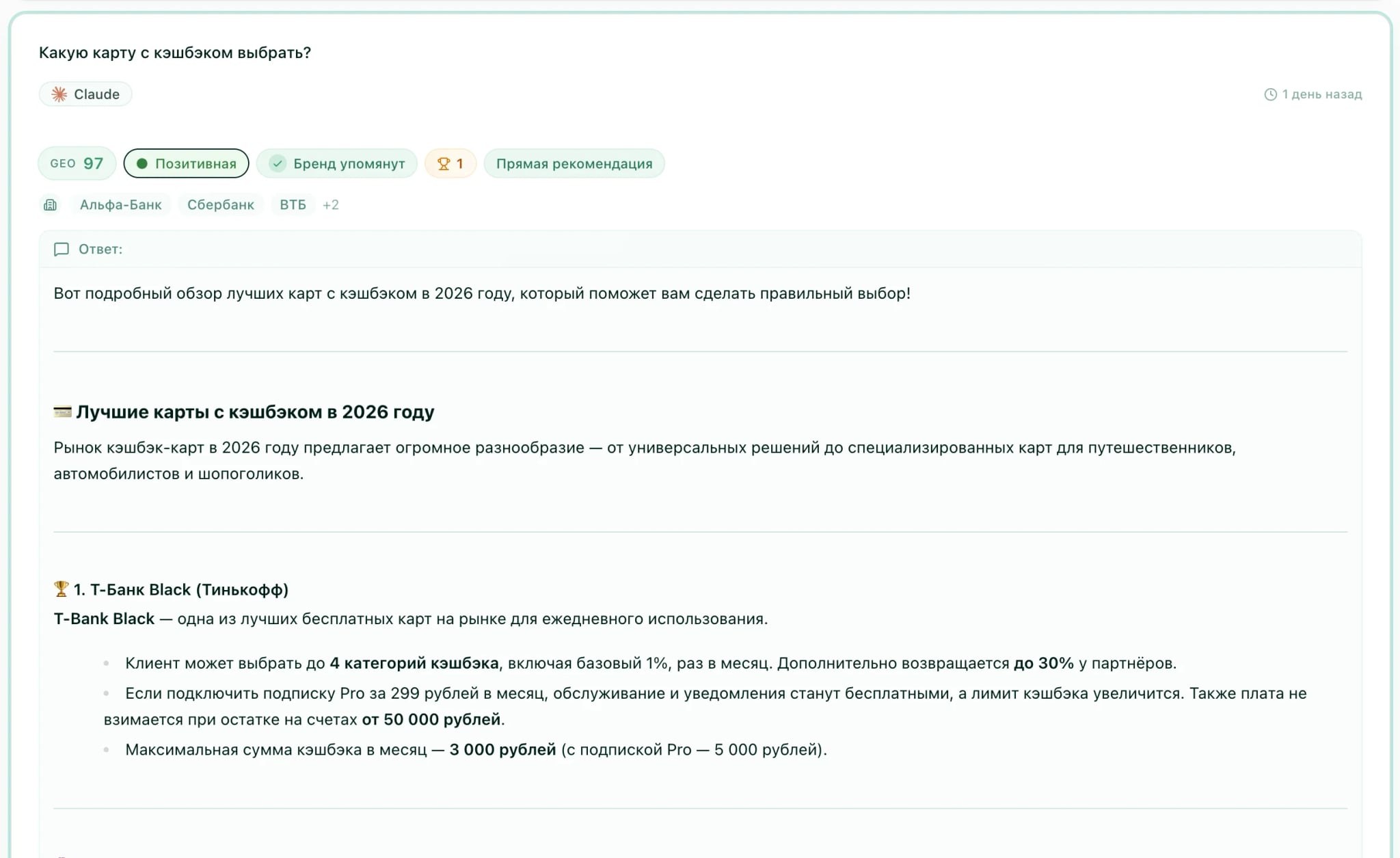
Claude's response to "Which cashback card should I choose?" — T-Bank mentioned at #1 with a direct recommendation and GEO score 97.
Ranking metrics
Every brand and competitor in the ranking is scored on five metrics:
Domain citation rate
Share of AI responses that include a direct link to the brand's domain. Tells you how often AI providers cite the brand as a source, not just name it.
Response coverage (mention rate)
Share of AI responses that mention the brand, out of all prompts in the niche. Tells you how often AI providers recall the brand.
Average position
Average rank of the brand in the list of mentioned companies. 1.0 means it's always named first. Lower is better.
Sentiment
How brand mentions break down: positive (praised), neutral (just named), and negative (criticized). Shown as a share of all mentions.
How the ranking is built
The ranking is generated automatically from the collected data:
- For each niche, we take the top 20 companies with the most mentions in the period.
- Companies are ranked by mention rate — the more AI providers name a brand, the higher it ranks.
- We track position change vs. the previous calculation so you can see movement.
- Data is recalculated regularly on a 30-day rolling window, which smooths random noise.
Tracked industries
The ranking currently covers 5 key industries in the Russian market:
Update frequency
The ranking refreshes on a regular cadence:
- We monitor AI responses on a regular schedule.
- The ranking is recalculated regularly.
- Each ranking is based on the last 30 days (rolling window).
- All metrics update automatically — no manual work needed.
Want to monitor your brand?
Connect your brand to GEO Scout and get AI visibility reports, broken down by provider.