A team runs your brand inside AI answers — you watch the same dashboard they do
Month one is a managed sprint. Days 1–5: baseline measurement plus on-site fixes and GEO content. By day 14: external publications. Through day 27: corrections based on how AI responds. From month two — daily monitoring on the GEO Scout platform, run by you or watched by the team.
30-minute call: we show your brand's current visibility and assemble the stable set we'll track through the first-month sprint.
- Team plus your platform access
- Month-1 sprint + bonus week
- Stable set for tracking momentum
From "we have no bandwidth for GEO" — to a managed channel on a shared platform
Brands where marketing or PR sees the weight of AI answers and wants to move faster than hiring a dedicated GEO specialist. We close month one as a sprint and leave you the platform with the same charts the team works against.
GEO as another task without an owner
- No clear picture of where the brand gets cited in AI answers and where competitors took its place
- The team is buried in SEO and performance — no one to pick up a new channel
- Vendors promise growth but skip measurement and a shared dashboard
- Hypotheses rest on one person's enthusiasm, not a regular cycle
A sprint plus a platform both sides actually work on
- You see your stable prompt set and visibility charts updated daily
- Month one is closed by the team: technical fixes, GEO content, external publications
- From month two — daily monitoring on the same platform you can open yourself
- AI visibility is a measurable number in your stable set, not a "let's try something"
Platform, sprint, and execution — in a single contract
We use GEO Scout as the shared data source for you and the team. The month-1 sprint covers on-site fixes, GEO content with internal linking, and external publications. From month two — monitoring and corrections.
GEO Scout with your stable set
A Pro or Business subscription. We lock in 30 or 50 priority prompts and 3 or 4 providers for daily measurement. All 12 platform providers stay available for ad-hoc checks.
Technical fixes and GEO content with linking
In the first 14 days we update robots.txt, sitemap, and schema, rewrite priority pages for model citation, and build internal linking so AI finds answers on your site, not your competitors'.
Distribution on third-party sources
Days 7–14: we ship external articles targeting prompts on sources the models already cite. Days 14–27: we top up distribution where the lift hasn't landed yet. Beyond AI citation, these publications bring direct referral traffic from the sources themselves and feed organic SEO — no separate PR or SEO track required.
Final measurement and the next plan
On the bonus week on top of the subscription we capture the final reading against the stable set, lock in the lift, and agree on the month-2 format: drive it yourself or stay on the managed track.
Two subscription formats: Pro and Business
A stable set is a fixed list of prompts × providers measured by AI every day, so you watch momentum on a chart. The team optimizes against this exact set so every shift is measurable. All 12 providers stay available on the platform for ad-hoc checks.
30 prompts × 3 providers
For brands focused on a single niche or single market. ≈90 daily readings are enough to spot a shift on priority prompts and decide what to correct.
- 30 prompts in the set
- 3 providers tracked
- ≈90 readings per day
50 prompts × 4 providers
For brands with multiple segments or languages. ≈200 daily readings cover an extended prompt map and leave headroom for distribution hypotheses.
- 50 prompts in the set
- 4 providers tracked
- ≈200 readings per day
On-site fixes implemented by the GEO Scout team
We take the sprint specs into execution — robots.txt, sitemap, schema, rewritten pages, internal linking. Or your developer ships them from our specs.
Platform + corrections on request
After the sprint you pay only for the Pro or Business subscription. New publications, distribution, and technical fixes are agreed on demand.
A measurable shift — in 30 + 7 days of the first month
No "let's check back in six months." Each step has a fixed day range and a verifiable artifact. On the bonus week on top of the subscription we capture the final reading against the stable set.
- 01KickoffDays 1–5
Baseline + first on-site fixes
We capture the baseline reading against the stable set and assemble the source map for external publications. In parallel we start on-site work: technical fixes, GEO pages, internal linking.
Baseline captured, on-site in progress - 02PlanDays 5–7
Content plan across sources
We agree the list of external sources, topics, and priority order with your side. Locked: what ships where, who reviews, who publishes.
Content plan ready to go - 03DistributeDays 7–14
External publications go live
We ship the agreed materials to external sources alongside ongoing on-site work. Goal: land in the sources models already cite in their answers.
External materials published - 04ObserveDays 14–27
Corrections based on AI response
We watch which materials the models picked up and how the stable-set answers changed. If needed, we top up distribution or rework on-site where the shift hasn't happened.
Corrections shipped - 05Final+1 week
Final reading against the stable set
On the bonus week on top of the subscription we capture the final reading. We compare it against the day-1 baseline using the same stable set — that's the sprint result, ready to show team and leadership.
Lift confirmed in the data
Daily monitoring — yours or ours
The month-1 sprint leaves you a foundation: an optimized site, published materials, and a stable set with clear momentum. The platform keeps measuring AI responses every day — you choose who watches.
You drive it yourself
Keep platform access on a Pro or Business subscription. You react to dips in the stable set and order articles or fixes on demand, when you need them.
GEO Scout subscription, no managed service
The team watches visibility
The team keeps an eye on the stable set every day. On a dip we agree fixes with you — on-site, in content, or in distribution — and ship them. Articles on request, not as a fixed pipeline.
Managed by event, no mandatory content pipeline
The team and you — on one dashboard
Visibility looks the same to client and team. That changes the conversation: you don't argue "is it growing," you decide "where do we add distribution for this prompt."
- 01The same stable prompt set and the same visibility dashboard
- 02Charts and events open in real time on both sides
- 03The team's corrections show up on the platform, not just in a report
Not promises — concrete shifts in numbers
The team optimizes the brand for the prompts that bring customers and reports against every metric. All numbers live in a stable set both sides can see.
Higher share of voice in AI answers
The brand shows up more often in answers from ChatGPT, Claude, Perplexity, Gemini, and Alice on the priority prompts in your category.
Your domain shows up as a source
Internal pages and external publications land in the source list AI models cite back to the user.
AI answers + search + clicks from publications
External articles bring direct referral traffic from third-party sources, optimized pages drive organic Google and Yandex traffic, AI citations add clicks from model answers. One team's work feeds three traffic streams — without separate SEO or PR tracks.
The same picture for you and the team
Not a monthly report — a live dashboard. Open momentum any time, see exactly what the team shipped.
Defined deliverables — not vague "ongoing support"
We lock down in the contract what ships in the sprint and what ships in monitoring mode, so expectations align from day one.
Stable-set readings
GEO Scout captures responses across 30 (Pro) or 50 (Business) prompts × 3–4 providers every day, with no manual work on your side.
Dashboard plus exports on request
Corrections on dips
From month two the team spots a drop in the stable set and agrees with you what to fix — on-site, in content, or in distribution.
Platform alert + a fix in flight
Visibility momentum report
What changed in model answers over the period, which hypotheses paid off, what the team picks up next.
Report + product-lead commentary
Sync with your team
We walk through stable-set momentum, priorities for the next cycle, and align with marketing, SEO, and editorial.
60-minute sync, decisions captured
We use GEO Scout ourselves — here's the result
GEO Scout monitors its own visibility in Yandex with Alice. 0% to 46% in 10 days.
0% → 46%
Visibility growth in Yandex with Alice in 10 days
x11
Visibility multiplier in the first week of optimization
21.9%
Share of Voice — the share of AI responses where the brand is mentioned vs all competitors.
54.5%
Citation Share — the share of source citations pointing to our domain vs all competitors.
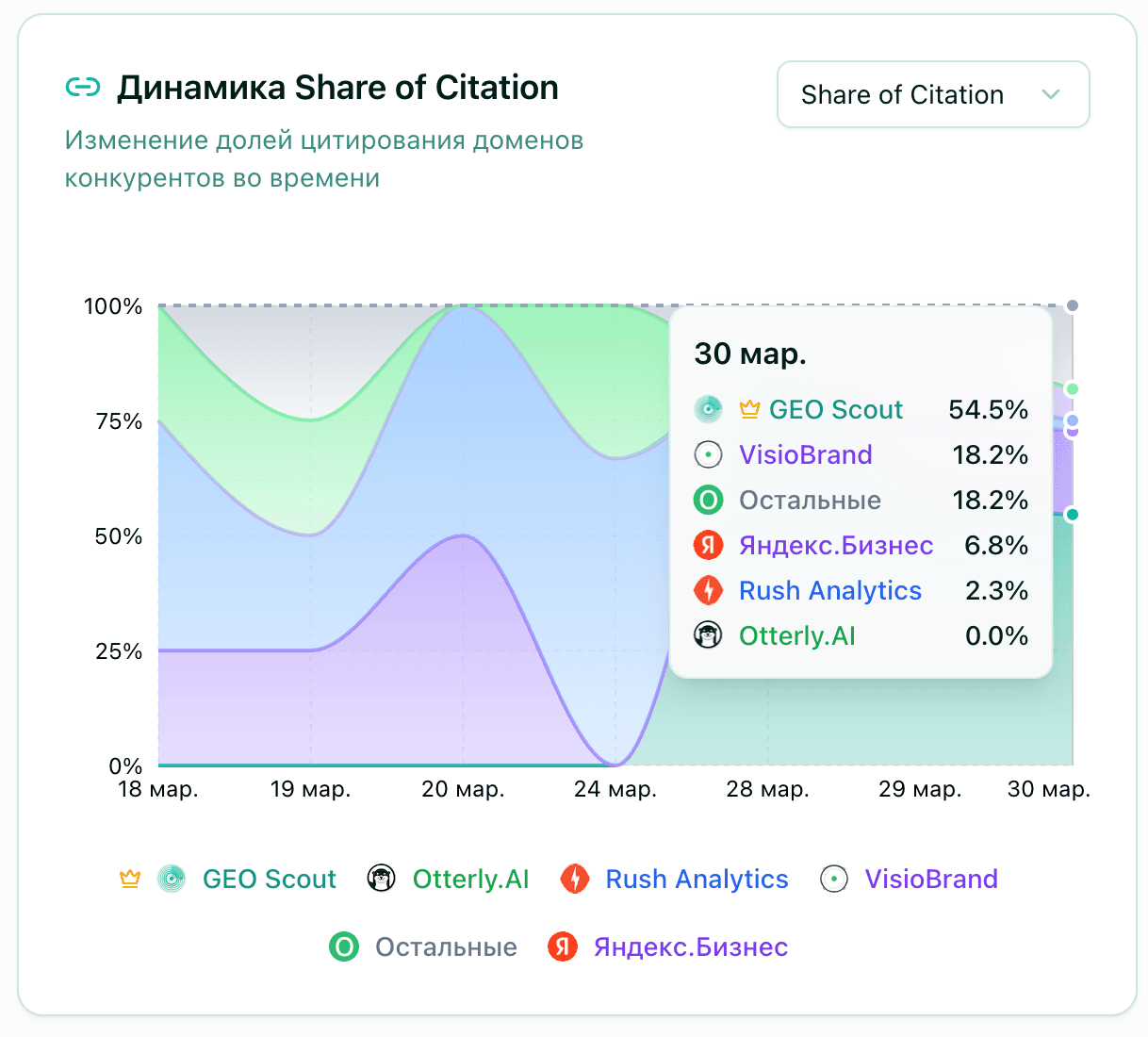
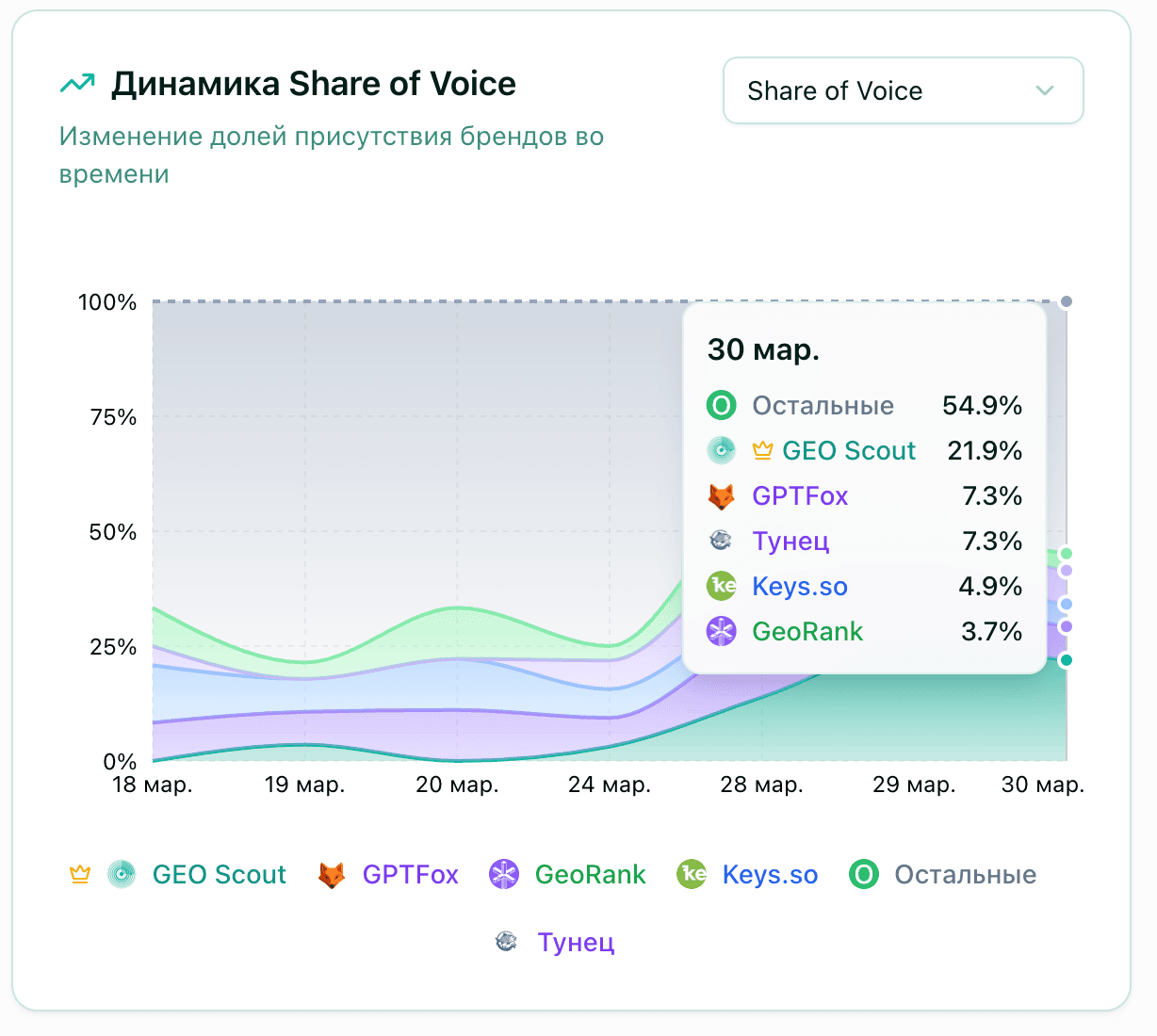
evidence · AI responses
Real AI responses
Screenshots of real AI responses recommending GEO Scout
A real working pack — not slides full of promises
Below is a slice of the working documents a brand receives during the month-1 sprint. Every file opens as a PDF.
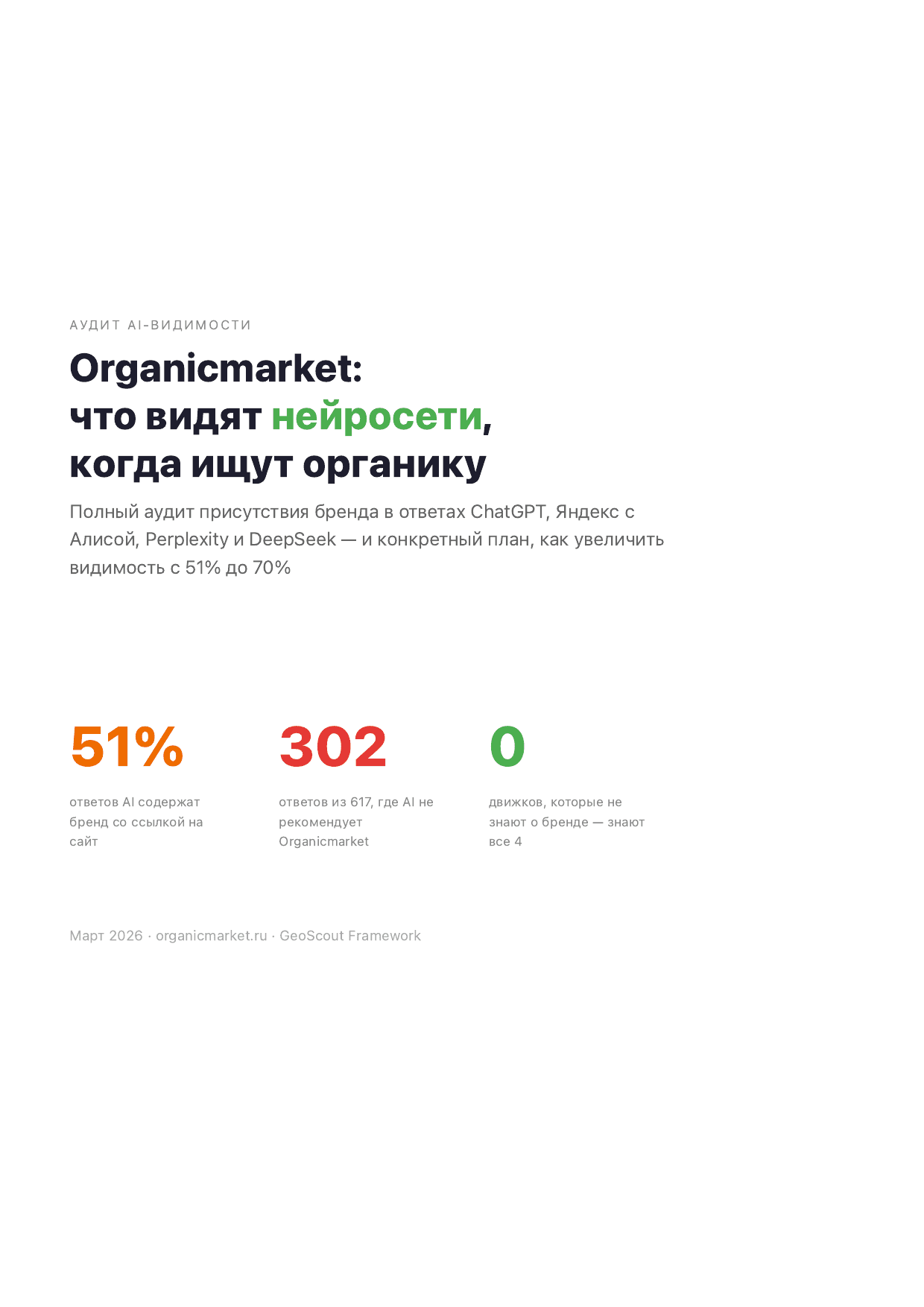
Full GEO audit of the brand
Diagnostic of AI visibility, competitive landscape, site issues, and the expected lift from priority sprint tasks.
Open sample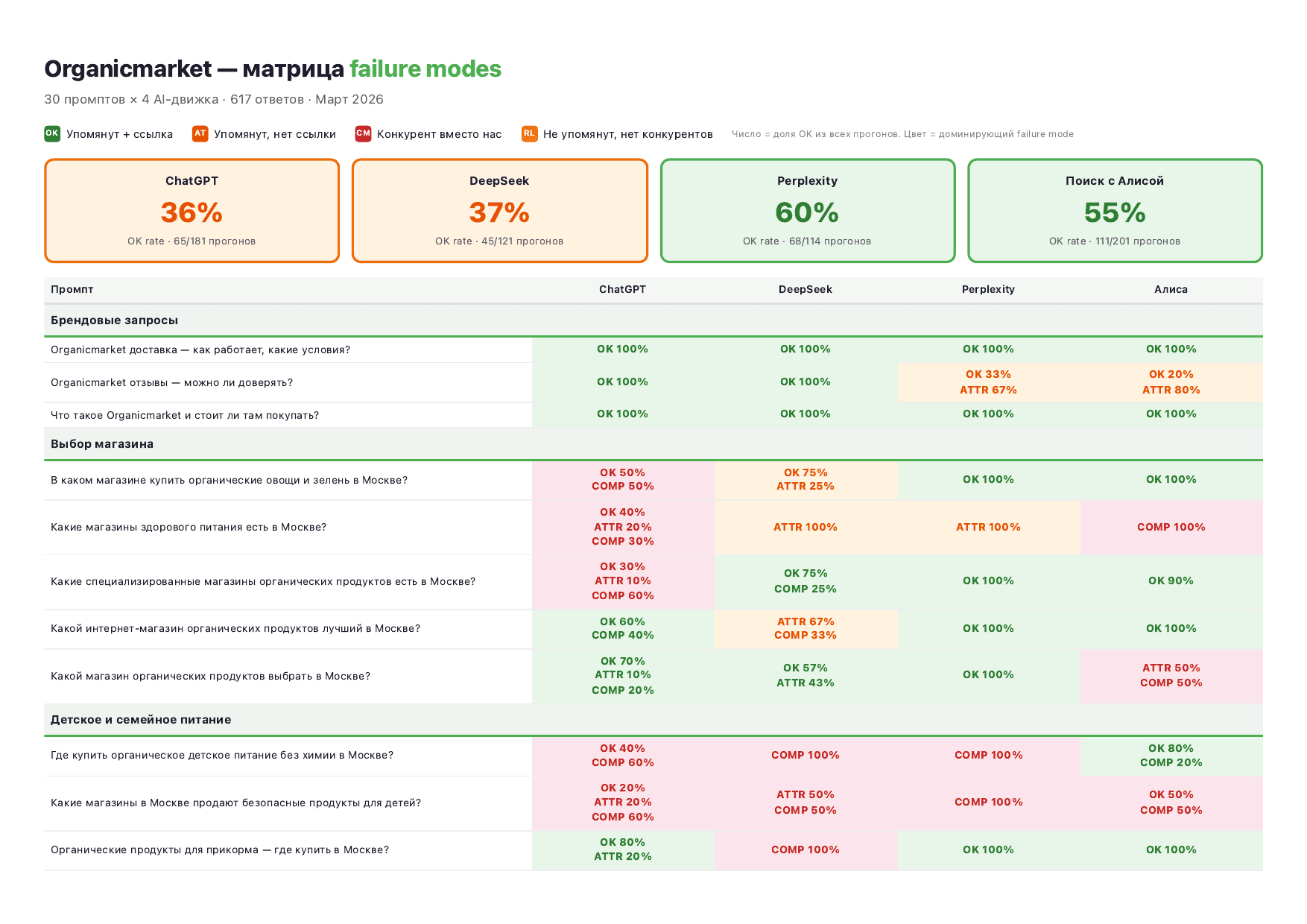
Prompt failure matrix
A breakdown for every prompt in the stable set: where the brand is already cited, where the link drops, where competitors take the slot.
Open sample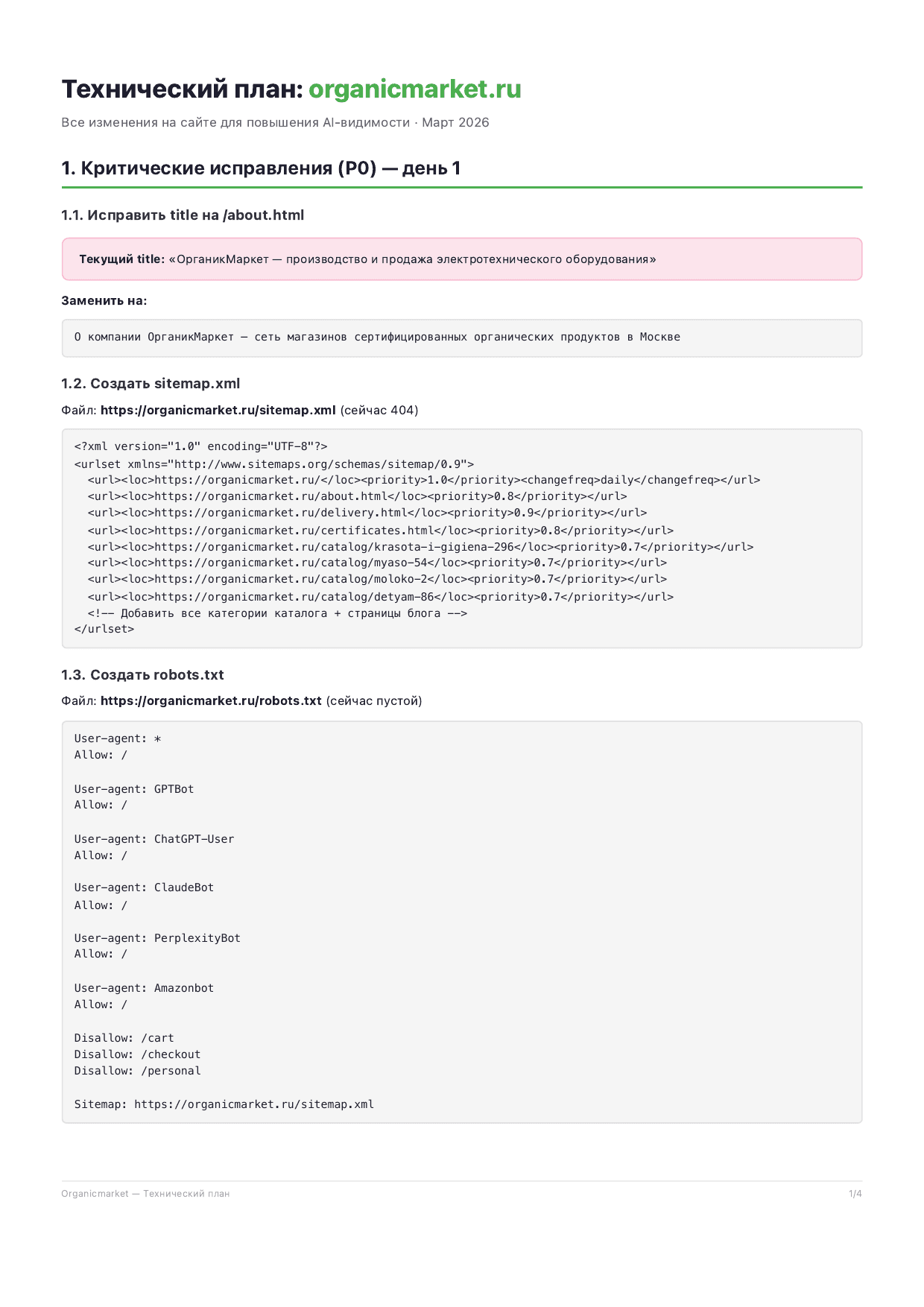
Technical fixes plan
Priority work on robots.txt, sitemap, schema, and page structure, sorted by impact and implementation cost.
Open sample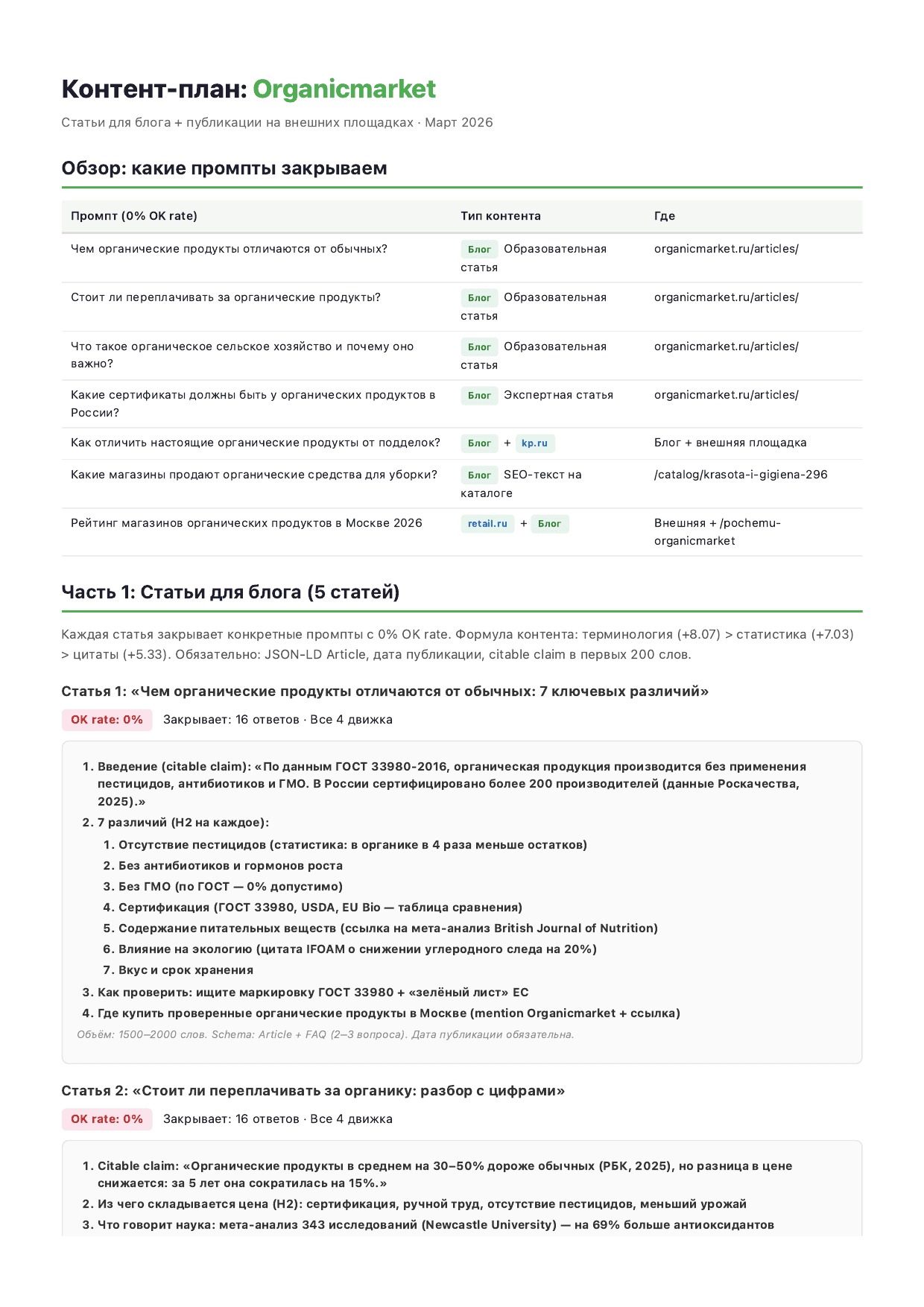
Content plan for citation
Topics, formats, and sources that close the gaps in the stable set and bring AI traffic to the brand.
Open sample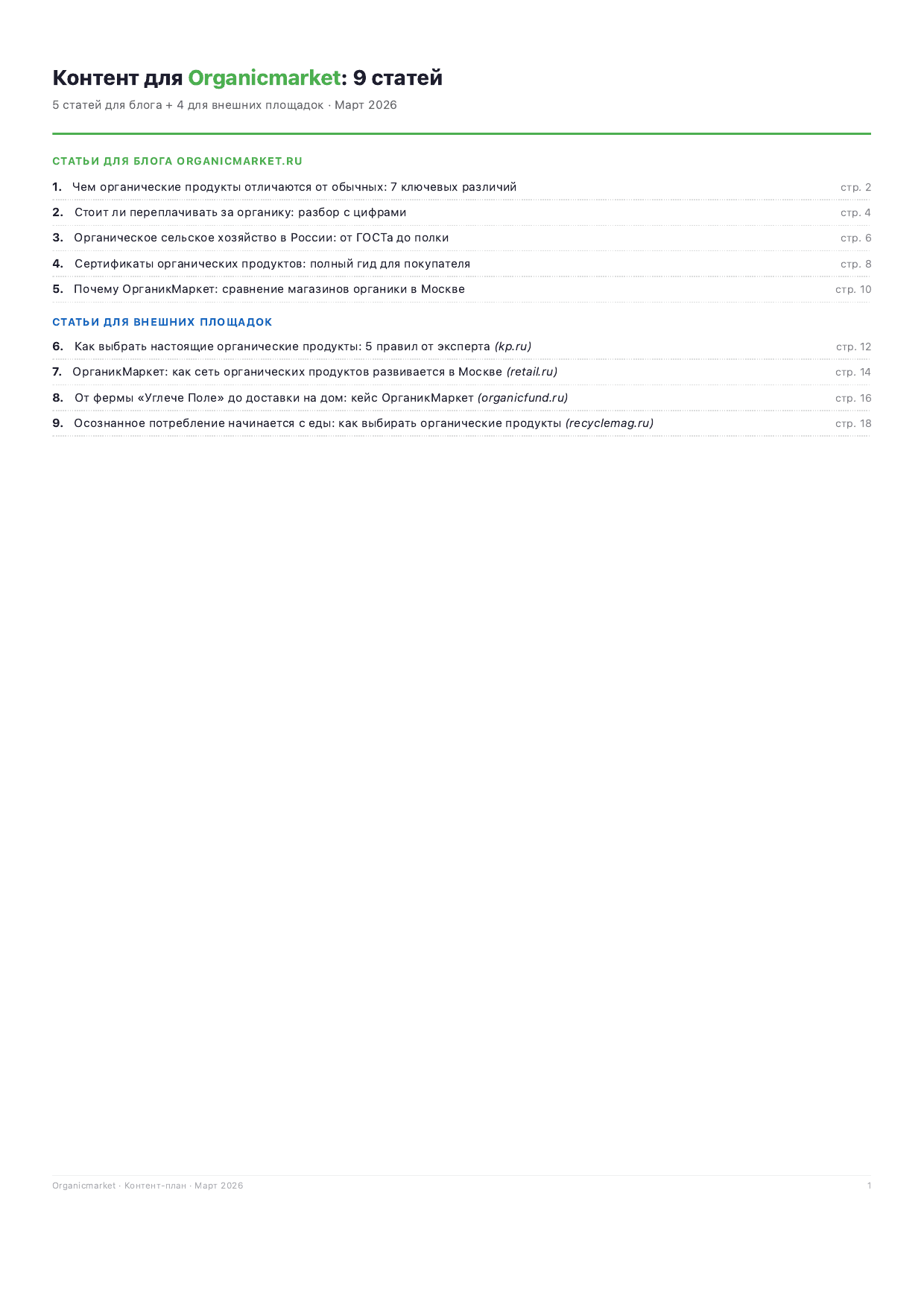
Ready-to-publish article pack
Drafts ready for the blog and external sources — sign off and ship without internal rewriting.
Open sample// This is one client sprint pack. In real engagements documents are tailored to your stable set and refreshed as readings come in.
What people ask before starting
If a question isn't covered here — we'll answer on the first call, grounded in your niche and your current stable-set visibility.
What is a stable set and why 30 or 50 prompts?
What do I get in the first-month sprint?
What happens in month two and beyond?
What does the bonus week on top of the subscription include?
How is this different from a regular GEO Scout subscription?
Beyond AI visibility — do I also get regular traffic?
What is GEO optimization and how is it different from SEO?
What does the GEO audit in the sprint cover?
You run an agency or consultancy
If you want to plug GEO into your offering and run several client brands on the platform, there's a dedicated partner program.
Open the agency pageJust the platform, please
If you have the team and the time, start with a GEO Scout subscription and run the stable set yourself.
View pricingWe'll review your brand and assemble a stable set for the sprint
On the call we'll show where the brand stands in AI answers today, scope the work for the first-month sprint, and discuss the month-2 format: drive it yourself or stay managed.
We capture starting visibility against your stable set
We show where the brand loses ground in AI answers
We scope the work for the month-1 sprint
We agree the month-2 format — self-driven or managed
The session is free. Afterwards we'll send a short doc with current brand visibility and a proposed stable set for tracking momentum.