How to check the accuracy of AI answers about your brand
Find factual errors in AI descriptions of your company: prepare reference facts, review claims, distinguish contradictions from omissions, and inspect source links.

A customer asks about a product. AI recommends your company but reports a 12-month warranty instead of 24 months. A visibility report counts a successful mention. The customer reads an incorrect purchase condition. Answer accuracy monitoring exposes that difference separately from brand visibility and sentiment.
This workflow works for a manual review of a few answers and for regular checks in GEO Scout’s Accuracy section.
Visibility, perception and factual accuracy answer different questions
Visibility tells you whether your brand appears. Brand perception describes the role and attributes assigned to it alongside competitors. Accuracy asks whether a specific claim agrees with verifiable information.
“The service is inconvenient” is an opinion. “The service does not support CSV export” is a checkable claim. These need different responses: the first calls for context; the second can be compared with product documentation.
Confident wording is not evidence. OpenAI acknowledges that ChatGPT can produce incorrect facts and fabricated references and recommends checking important information against reliable sources. Source: OpenAI’s guidance on ChatGPT accuracy.
Step 1. Prepare reference facts
Prioritize information that affects a customer’s decision: products, functions, service areas, warranties, compatibility and limitations. Include the model, market or plan whenever it changes the meaning.
A usable fact is: “Model X purchased in the UK after 1 September 2026 has a 24-month manufacturer warranty.” “We always offer a generous warranty” cannot be checked without guessing.
Keep one claim per fact. Split manufacturing, delivery and installation into separate statements. See how to prepare company facts for AI checks for a reusable template.
Step 2. Collect answers to real customer questions
Choose questions people ask when researching your company or selecting a product. Start with purpose, product range, limitations and service conditions.
Avoid putting the desired answer into every prompt. “Confirm that our warranty is 24 months” tests a different situation from “What warranty does Model X have?” Keep clarification scenarios separate in your working notes.
For each answer, retain:
- the exact prompt and full response;
- the provider, date and operating mode, when known;
- the language or location if it changes applicable conditions;
- available links and the passages associated with them.
A single accurate answer does not characterize every future answer. Keep questions and observation conditions comparable when repeating the audit.
Step 3. Separate contradictions from omissions
Consider an illustrative manufacturer that makes boats and engines. “The company makes boats” may be brief but correct. “The company only makes boats and does not manufacture engines” contradicts the reference facts.
Distinguish three situations:
- Agreement: the answer and reference give a 24-month warranty for the same model and market.
- Contradiction: the answer gives a different warranty under the same conditions.
- Insufficient context: the answer refers to another model or an unspecified plan. Find an applicable reference before calling it an error.
You can record an omitted service as a communication gap. Counting it as a factual error, however, would make the error count depend on answer length rather than truthfulness.
Step 4. Inspect the answer and its sources
Open the complete answer. A suspicious warranty statement may describe a competitor, quote an old review, or apply to another country. Automated assessments can also misread context.
If links are available, start with citations next to the claim. Check the page content, date and applicable conditions. A URL elsewhere in the source list does not prove that it supplied the incorrect wording. OpenAI also notes that search results and citations can be incomplete or outdated. Source: OpenAI on checking search results and citations.
When no sources are available, record that limitation rather than inferring a source from similar wording.
Automating the workflow in GEO Scout
In Accuracy (Beta), add facts manually, import a CSV, or prepare them from text and knowledge-base materials. Review the wording before saving. Then select existing monitoring prompts; a separate branded cluster is unnecessary.
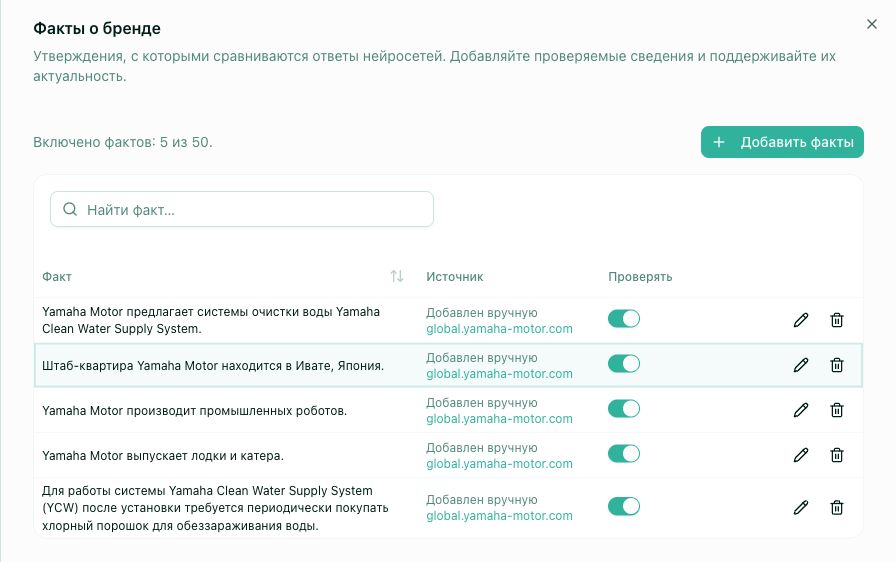
The screenshot shows facts prepared from official sources for a Yamaha Motor demonstration. This is a product example, not a Yamaha customer case study.
You can enable 50 facts per brand. Disabling a fact frees a slot. Paid subscriptions allow 20 prompts for accuracy checks. For a larger selection, contact support in chat or email support@geoscout.pro. The check uses saved answers, so monitoring must collect them first.
Subscription users initiate the first check; subsequent checks run weekly and the section shows the next scheduled date. Partners launch checks manually at 1 credit per successfully checked answer, regardless of the number of facts or findings.
Open a contradiction to review the answer and reference fact. Incorrect assessments can be adjusted manually. The accuracy guide explains the screens and launch process.
Real example: Yamaha consumables in an AI answer
On November 2, 2026, we collected nine answers to three questions in Russian from DeepSeek, Alice AI and Search with Alice. After refining five reference facts, GEO Scout matched 14 claims and automatically flagged two discrepancies about consumables.
When asked what water purification solutions Yamaha Motor offers, DeepSeek correctly described Yamaha Clean Water Supply System but attributed low operating costs to a phrase meaning “the absence of a need for chemical reagents”. The official Yamaha specifications require periodic purchases of chlorine powder for disinfection after installation.
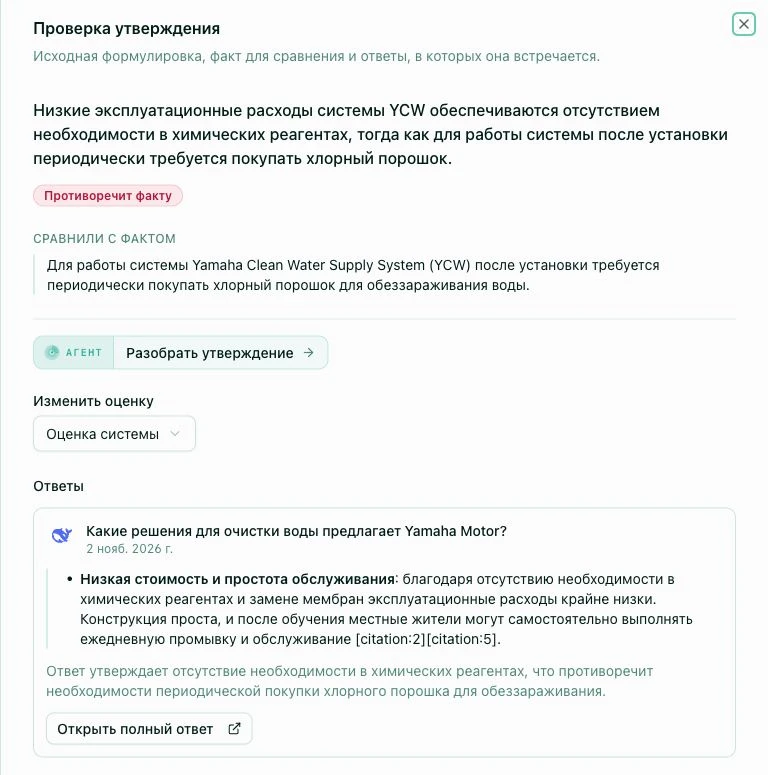
The full DeepSeek answer also mentions chlorination. This is an inconsistency within the answer, which is why readers should inspect the original rather than label the entire answer incorrect. Another answer was flagged for a similar broad statement about not needing consumables.
A general fact such as “Yamaha makes water purification systems” would not reveal this discrepancy. A specific maintenance requirement did. The official page already contains the correct clarification; a citation beside questionable wording does not establish an error on the cited page.
We did not edit the answers or automatic verdicts. This small run illustrates the checking process, not the overall error rate of any model. See the facts, full answer and sources in the worked example in the guide.
Measure results and assign follow-up work
For an internal audit, a useful measure is the share of checked answers containing confirmed contradictions: affected answers divided by all checked answers in the same sample. An answer with three errors counts as one affected answer. This is a working audit metric, not a universal model-quality score.
Keep periods, prompt sets and reference facts comparable. Adding ten facts may expose more contradictions without any change in the underlying AI answers.
Assign an action to each confirmed issue: clarify your website, update a partner’s product page, contact an editor, or correct an outdated reference fact. After changes, evaluate new answers. Historical answers do not rewrite themselves, and there is no fixed timetable for a model to adopt your wording.
Start by preparing company facts, then follow the check setup guide to connect each finding with evidence and an actionable correction.
Частые вопросы
How do I check whether ChatGPT describes my company correctly?
Is it an error if AI leaves out one of our services?
Does a low error rate mean every answer is reliable?
Do I need separate branded prompts in GEO Scout?
How often does GEO Scout check accuracy?
Related
Company facts for AI monitoring: how to prepare a reliable reference
Build a company fact set for AI answer checks: what to include, examples for manufacturers and SaaS, update rules, and how reference facts differ from model training.
How to Fix AI Errors and Hallucinations About Your Brand
A practical guide to correcting AI hallucinations: wrong prices, outdated information, incorrect brand descriptions. Diagnosis, correction strategy, and monitoring results.
What Is GEO Optimization: Definition, Examples, Tools
Complete definition of GEO (Generative Engine Optimization): history of the term, how it works, practical examples, tools, and how it differs from SEO and AEO.